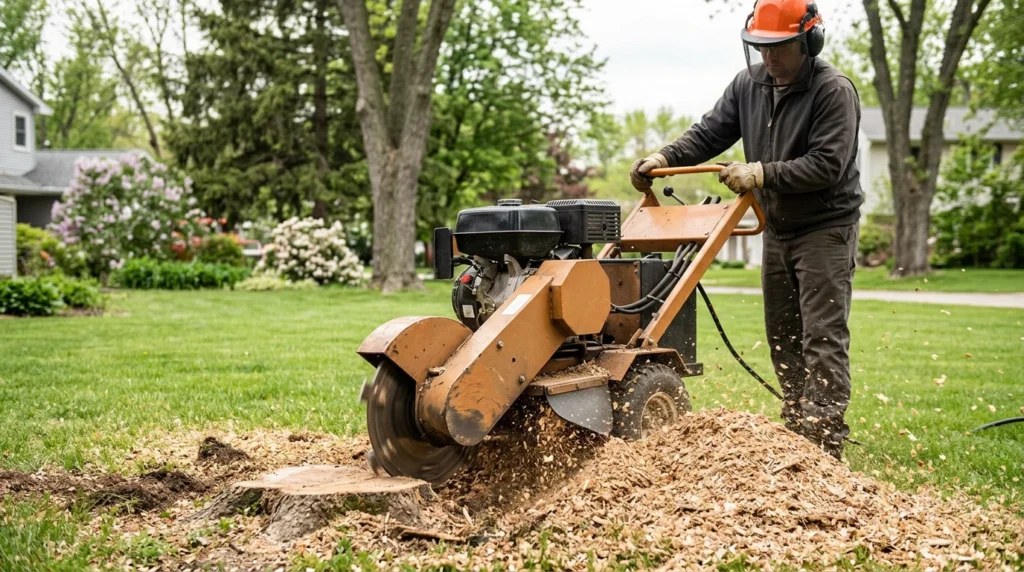
Quick answer: You can find stump grinding by calling local tree services and asking about machine access, depth of grind, cleanup, and whether they’ll handle surface roots. Expect a grinder to turn the stump into wood chips, leaving a shallow depression that can be backfilled with soil or mulch. Most jobs take under a few hours, but tight access, large stumps, and rocks can slow things down.
What Stump Grinding Actually Does
Stump grinding removes the visible stump by shaving it down with a rotating cutting wheel, typically to a few inches below grade so you can cover the area with soil and seed or mulch. It does not remove the entire root system, so some roots may remain underground and slowly decay over time.
If you’re searching for stump grinding near me, focus on what you want the area to become afterward. Grinding is usually the fastest way to make the spot usable again, but it’s not the same as excavation. If you plan to replant a tree in the exact same spot, ask about a deeper grind and how much backfill you’ll need.
After grinding, you’ll have a pile of chips mixed with soil. Some homeowners reuse chips as mulch (best for beds, not for mixing into planting soil), while others prefer the debris hauled away so the area can be topsoiled and leveled.
How to Compare Local Stump Grinding Services
Start with access. A grinder needs a path through a gate, between structures, or around landscaping. Ask the service what machine size they’ll bring and the minimum width they need. A narrow gate or steep slope can require smaller equipment, which can take longer.
Next, get clear on depth and footprint. Many crews grind the stump several inches below grade, but if you’re installing sod, pavers, or a new planting bed, you may want a deeper grind and a wider pass to address the root flare. Also ask whether they’ll grind surface roots that stick up above the soil, since those are common trip hazards and mower-killers.
Finally, confirm cleanup expectations. “Cleanup” can mean raking chips into a neat pile, spreading them on-site, or hauling them away. If you want the spot ready for seed or sod, ask if they can backfill with soil or if you should plan to add topsoil yourself.
Common Problems That Change the Plan
Hidden metal, rocks, and old fencing can damage grinder teeth. If the tree had a swing, a sign, or nails in it, mention that upfront. A careful operator can work around debris, but it may slow the job.
Utilities and irrigation lines also matter. Call for utility locating before any digging, and tell the crew about sprinkler heads, shallow drain lines, or landscape lighting. Grinding is less invasive than digging out a stump, but it still disturbs soil and can nick shallow lines if nobody knows they’re there.
Watch for signs the stump is tied into a bigger issue: heaving soil, a nearby leaning tree, or multiple connected surface roots. In those cases, you may need broader root management or an arborist’s opinion before you change grade or hardscape the area.
What to Do After the Stump Is Gone
Plan for settling. As buried roots decompose, the soil can dip over months, especially with larger trees. If you’re aiming for a smooth lawn, keep a little extra topsoil on hand to re-level after a few rains.
Avoid mixing fresh wood chips into planting soil for new grass or flowers. Chips are fine as a surface mulch, but mixed into soil they can temporarily tie up nitrogen as they break down. A better approach is to remove excess chips, add clean topsoil, then seed or sod.
If you want help assessing access, grind depth, and cleanup so the area is ready for your next project, White Oak Tree Company can walk you through the options.